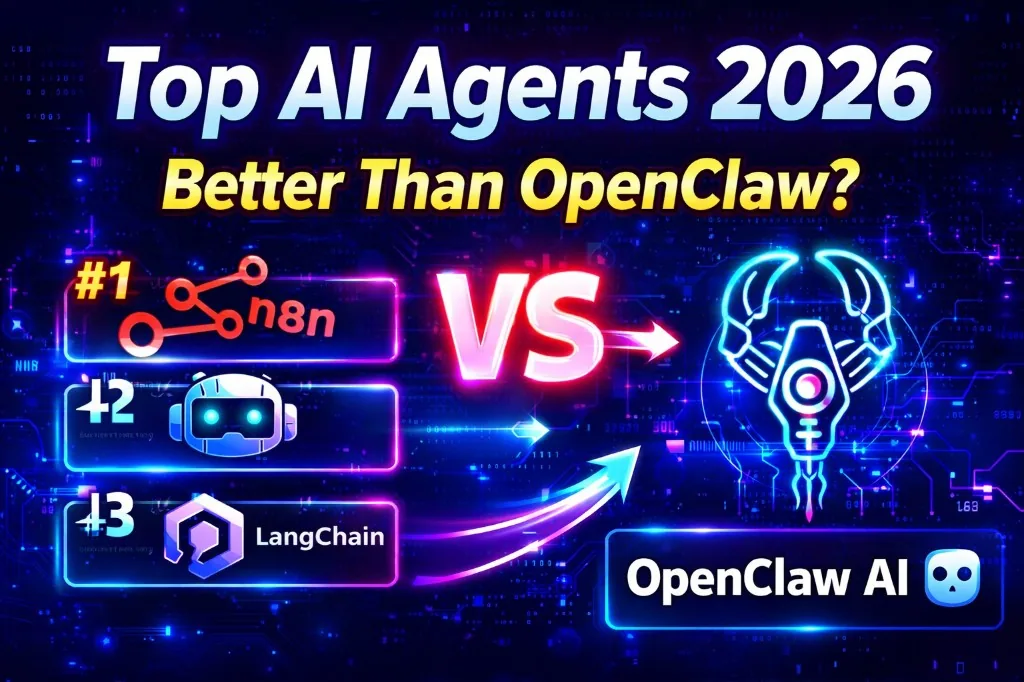
Top 5 AI Agent Tools Like OpenClaw AI (Ranked & Tested 2026)
You have seen the lobster memes. You have seen the GitHub graphs. For a few weeks in 2026, it felt like half of tech Twitter woke up and decided the future was not "another chatbot" but agents—things that do steps, break work into tasks, and sometimes even remember what they did last Tuesday. OpenClaw AI sits right in the middle of that storm: loud, open-source, a little chaotic, genuinely interesting.
Here is what I actually think after poking at this category for real: AI agent tools 2026 are not magic—they are permissioned automation with better marketing. Some are frameworks, some are workflow engines wearing a robot costume, and one or two are still coasting on 2023 hype. This list ranks five tools in the OpenClaw AI alternatives bucket—OpenClaw AI, CrewAI, LangChain, n8n, and AutoGPT—with honest tradeoffs, not a leaderboard for your ego.
Full disclosure: I did not run a lab with identical metrics and a perfect scorecard. Real life is messier. I tried happy paths, broke things on purpose once, and paid attention to how each tool wants you to think—because the mental model matters more than the logo. If you are hunting best AI agents lists to copy-paste into a budget, slow down: the invoice is not the tool; it is the integration plus maintenance plus the moment someone asks "why did it do that at 11 p.m.?"
If you want the deep dive on the name everyone is shouting about first, read our OpenClaw AI review before you buy a Raspberry Pi you will not use. For the wider tool landscape, our best AI tools 2026 roundup still holds up when you need apps, not frameworks.
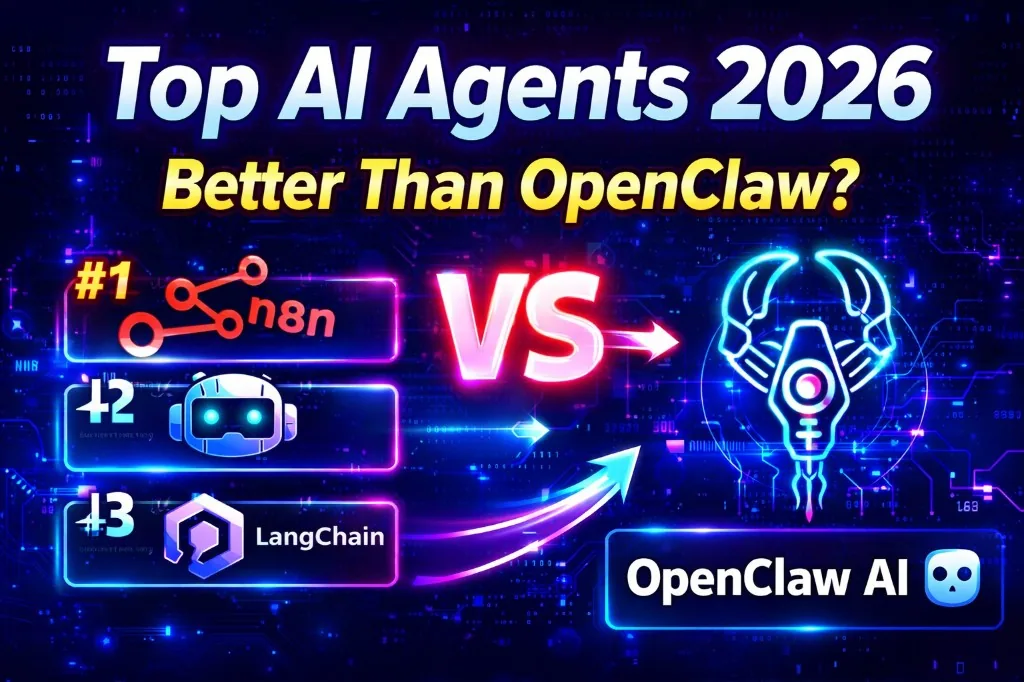
Ranked means opinionated. Tested means I actually tried to break them.
Why AI agents are trending in 2026 (and not going away)
Chatbots peaked at "write me a polite email." Agents promise "read my inbox, classify it, draft three replies, and stop if money is involved." That jump—from text to action—is why best AI agents chatter exploded. Businesses do not want more tabs; they want fewer mistakes and fewer Sunday-night catch-up sessions.
The catch: agents need boundaries. Give them sloppy permissions and you do not get productivity—you get a very confident intern who can delete a database. That is why the good AI automation tools in this space obsess over logging, retries, and human checkpoints. If that vocabulary is new, skim AI automation for beginners before you wire money to a webhook.
There is also a quieter reason this trend stuck: teams are tired of paying per seat for software that still leaves them doing manual glue work. Agents—done carefully—promise fewer handoffs and fewer "we forgot to update the sheet" moments. Promise is the keyword. The best AI agents are the ones your org can maintain without inventing a new religion.
Quick comparison: five AI agent tools (at a glance)
Not apples-to-apples—OpenClaw is a framework, n8n is automation glue, AutoGPT is a vibe from another era. Still, Google loves a table, and so do busy readers hunting AI agent tools 2026 comparisons.
| Tool | What it is | Best for | Vibe check |
|---|---|---|---|
| OpenClaw AI | Open-source personal agent framework | Local-first, channel-heavy assistants | Trendy, powerful, you own the mess |
| CrewAI | Multi-agent orchestration library | Role-based AI teams (researcher, writer, reviewer) | Great demos, needs clear specs |
| LangChain | Developer framework for LLM apps | Production apps, chains, tools, RAG | Industry default, learning curve is real |
| n8n | Workflow automation with AI nodes | Reliable ops: forms → CRM → AI → Slack | Boring wins—ships Friday |
| AutoGPT | Autonomous goal-chasing agent (classic) | Experiments, prototypes, cautionary tales | 2023 called; use with gloves |
One more thing about that table: it is not a replacement for reading docs. It is a map. The territory is your stack, your threat model, and your willingness to babysit logs. When people ask for OpenClaw AI alternatives in a hurry, they usually want a name to Google—not a deployment plan. Slow down long enough to answer "what happens when this fails?" and you will pick better AI automation tools by default.
Ranked breakdown: what each tool is actually for
Below is my ranked list for 2026 if you care about shipping—not collecting stars. Your mileage varies by stack, patience, and how much sleep you are willing to sacrifice.
1. OpenClaw AI — the one everyone is comparing everything to
If you only read one section, read the full OpenClaw AI review on ClickWise—this is the short version. OpenClaw AI shines when you want an assistant that feels close to your machine and your channels, with community energy behind it. It is not the easiest on-ramp; it is the one people talk about because it feels like the future arrived as an open repo instead of a press release.
Where it wins: momentum, extensibility, and the feeling that you are not renting every decision from a single vendor. Where it hurts: setup friction, operational responsibility, and the temptation to over-scope your first weekend. If your question is purely "what is the closest thing to OpenClaw AI but not OpenClaw AI," you are asking the wrong question—start from the job, not the mascot.
Honest gripe: anything this flexible will eat weekend hours. That is not a bug; it is the price of owning your runtime.
2. CrewAI — when one bot is not enough
CrewAI is the "what if we had a tiny company inside the terminal" toolkit—roles, handoffs, tasks. It is genuinely fun to prototype with. The failure mode is always the same: vague job titles and vague prompts turn into four chatty models agreeing with each other. Nail the spec, and it feels magical for research and content pipelines.
I like CrewAI when the task naturally splits—research vs outline vs critique. I do not like it when people use it to avoid deciding what they want. If your crew is three copies of the same personality, you do not have a crew; you have a chorus.
3. LangChain — the boring backbone that powers half the industry
If you are building software—not vibes—LangChain (and the ecosystem around it) is still the default answer when someone says "we need RAG" or "we need tools + memory." It is not trendy on TikTok; it is what your backend engineer reaches for when the demo needs to survive Monday traffic.
Complaint you will hear online: complexity. Fair. But complexity is not the same as uselessness. LangChain is a toolkit; if you bring a hammer and expect a house, you will blame the hammer. For AI agent tools 2026 discussions, LangChain is often the adult in the room—less viral tweet, more production incident prevention.
4. n8n — automation first, AI second (and that is a strength)
n8n is not "an agent" in the sci-fi sense—it is workflow automation that can call AI when it matters. In the real world, that is often what businesses pay for: fewer dropped leads, fewer copy-paste hours. If you want money stories, our make money with n8n guide is basically a receipt printer for freelancers. Pair it with best AI automation tools when you are picking glue between apps.
Here is why n8n ranks high for me even in an "agents" article: most companies do not need a philosopher-king model chain on day one—they need a reliable pipe from form to CRM to Slack, with optional AI summarization. That is not less intelligent; it is more honest. If you are comparing orchestration options, n8n vs Zapier vs Make is the pricing and scaling conversation you cannot skip.
5. AutoGPT — the ghost of agent hype past
AutoGPT belongs on the list because people still Google it next to OpenClaw AI alternatives. In practice, it is a reminder of how fast this space moves: autonomous loops are exciting until they loop stupidly at scale. Use it to learn—then graduate to something with guardrails.
I am not dunking on it for sport. AutoGPT helped a generation of people understand what "autonomous" could mean. In 2026, the lesson stuck even if the default tool did not. Keep it in the toolbox labeled education, not production—unless you enjoy explaining yourself to finance.
Pros and cons (the category, not cheerleading)
Pros of modern AI agent tools:
- You can automate real work—not just generate paragraphs.
- Open frameworks reduce lock-in if you actually self-host.
- Communities ship integrations faster than vendors ship slide decks.
Cons nobody puts in the thumbnail:
- Permissions are everything—sloppy defaults become incidents.
- "Agent" often means more debugging, not less.
- Costs hide in API bills, GPUs, and your calendar.
Which AI agent tool is best for you?
Best for developers
LangChain if you are building product. OpenClaw AI if you want a local-first assistant you can hack on. CrewAI when your problem is multi-role orchestration and you like Python. Skip the drama: pick one, ship, then argue on GitHub.
If you live in commits and PRs, you already know the rule: frameworks are debt you accept because they save time. LangChain debt is familiar to hiring. OpenClaw debt is newer, but at least it is yours. CrewAI debt is "did we define the roles clearly?"—which is surprisingly often a people problem dressed as a tech problem.
Best for freelancers
n8n wins paid projects because clients understand "automation" invoices. Layer AI where it saves time, not where it sounds cool. For client acquisition math, how to get your first AI client still beats another framework install.
Freelancers also lose money when they sell the wrong abstraction. Selling "I will install an agent" sounds futuristic until the client asks for a spreadsheet that updates. Selling "I will stop leads from dying in your inbox" is boring—and bankable. The best AI agents story for solo operators is usually a workflow story with a brain attached, not a brain story with workflows attached.
Best for beginners
Start with n8n or a hosted chat product, then graduate. Jumping straight into agent frameworks because you saw a trend line is how you get discouraged before you ship anything useful. Read AI automation for beginners, then revisit OpenClaw AI when you know what "done" looks like.
Beginners deserve a boring win: one automation that saves an hour a week beats ten half-configured agents that stress you out. If you need a gentle on-ramp to models and prompts, our ChatGPT prompts guide is still one of the fastest ways to build taste before you build infrastructure.
Before you install: three rules that save you from yourself
First: name the failure modes before the success metrics. If you cannot describe how a bad run gets stopped, you are not ready for autonomy—no matter how good the AI agent tools 2026 marketing sounds. Second: keep secrets out of prompts and logs by default; treat keys like cash. Third: write the one-page "what this is allowed to do" doc before you show a client a demo—future you will thank present you when something weird happens at the worst possible time.
And yes—if you are still comparing OpenClaw AI alternatives because you want a spiritual successor, stop looking for a clone. Look for the same outcome: controlled automation with clear ownership. Sometimes that outcome wears a lobster logo; sometimes it wears a workflow graph. The logo is not the point.
Final verdict
If you want a single takeaway for AI agent tools 2026: the "best" tool is the one you can operate safely on a Tuesday night. OpenClaw AI is the headline; n8n is often the paycheck; LangChain is the engineering default; CrewAI is the clever team demo; AutoGPT is the history lesson. Mix hype with receipts, and you will be fine.
Still shopping OpenClaw AI alternatives? Bookmark the OpenClaw AI review, keep best AI tools 2026 open in another tab, and remember: ranking lists are opinions with citations. The only ranking that matters is whether your stack ships.
Last thought, because someone will ask: no, I am not claiming these five are the only AI agent tools 2026 worth knowing—there are more frameworks and more SaaS wrappers every month. I picked these because they show up next to OpenClaw AI in real searches, in real Slack threads, and in real "what should we use?" meetings. If your favorite tool is not here, the honest reason is space—not spite. Send the link, make your case, and if it survives a weekend of real work, it belongs in your stack.
FAQ
What are the best AI agent tools in 2026?+
What is the best alternative to OpenClaw AI?+
Are AI agent tools the same as AI automation tools?+
Is n8n an AI agent tool?+
Is AutoGPT still worth using in 2026?+
Related on ClickWise
OpenClaw AI review · Make money with n8n · Best AI automation tools · n8n vs Zapier vs Make
Keep Reading
Try Our Free Tools
Want more guides like this?
Join 50K+ readers getting weekly tips on AI, automation & making money online.
Subscribe Free