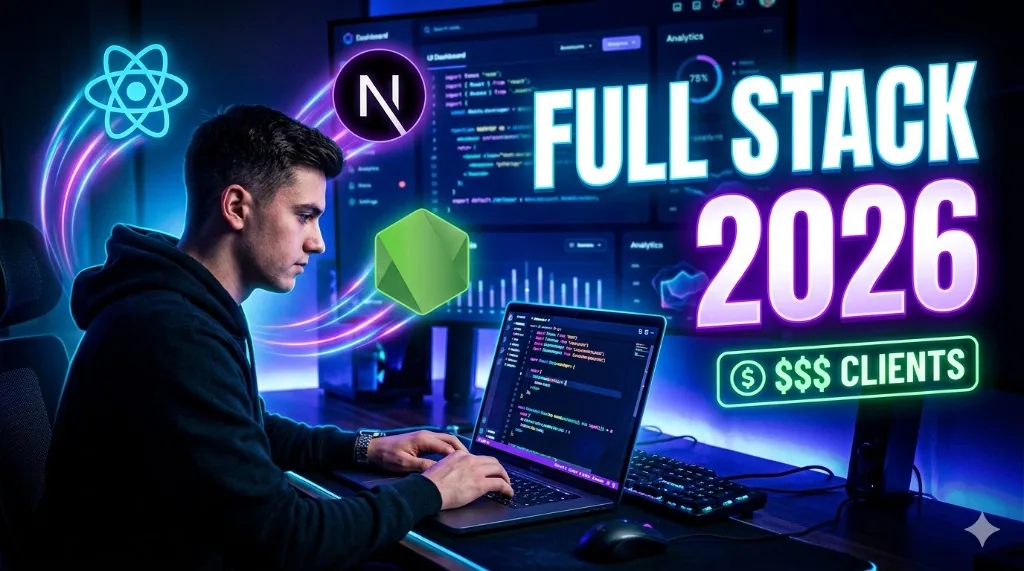
How to Build a Full-Stack Web App for Clients in 2026 (Beginner to Pro Guide)
You open another roadmap. It says learn HTML, CSS, JavaScript, TypeScript, React, Redux, GraphQL, Docker, Kubernetes, and maybe Rust. You close the tab and wonder if you should just drive Uber. That confusion is normal—and it is also why full stack web development pays: clients do not need another person collecting tutorials. They need someone who ships a login, a dashboard, and something hosted before their competitor does.
Full stack web app 2026 is not a mystery religion. It is a small set of outcomes—data in, UI out, permissions, and something live—wrapped in a stack you can explain in one breath. Get that right and you can build web apps for clients at rates that beat generic "I will do websites" gigs. This is the full stack freelance guide I wish I had before I burned three months on tools nobody asked for.
Fastest way to get started (no heroics)
- Pick one audience—local service businesses, creators, coaches, or indie SaaS—and stop pretending you serve everyone.
- Install Node.js, create a Next.js app, add Tailwind, and deploy one page to Vercel (or similar) this weekend.
- Build one CRUD feature: list → create → edit → delete with real validation—not a to-do from a tutorial that looks like 2014.
- Add auth (Clerk, Auth.js, or your host's pattern) so you understand sessions and protected routes.
- Connect one API: Stripe test mode, a webhook, or a MongoDB/Postgres collection—prove data moves end-to-end.
- Record a two-minute Loom walkthrough and put it above your PDF resume.
What clients actually pay for (hint: not your repo)
Nobody cuts a check for "I used React." They pay for outcomes: a dashboard that kills spreadsheet chaos, a client portal that stops DM support, a booking flow that fills the calendar, internal tools that replace five sub-accounts. Your job in a full stack web app 2026 pitch is to name the Tuesday-night problem and the Friday result.
AI automation fits here as glue, not a replacement for the app: classify leads, draft emails, summarize tickets—always with a human in the loop when money or reputation is on the line. Same idea as AI automation for beginners: trigger → route → optional AI → approval. If you sell that combo, read how to start an AI automation agency next to line up offers and pricing.
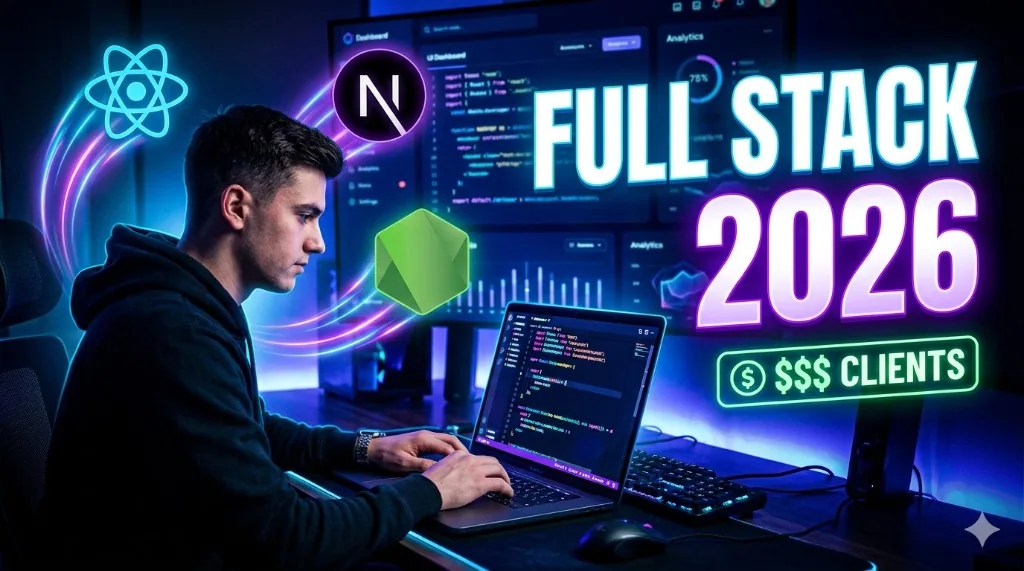
Ship something ugly that works before something pretty that never deploys.
Step-by-step: niche → stack → portfolio → offer → client
Step 1 — Pick a niche you can describe in one sentence
"I build web apps" is a hobby. "I build member portals for fitness coaches" is a business. Niches compress learning and make your portfolio feel intentional—same reason making money online in 2026 rewards sharp positioning over generic hustle.
Step 2 — Choose a stack buyers recognize: React, Next.js, Node.js, MongoDB
React for UI. Next.js for routing, server components, and API routes where you need them. Node.js on the server so you are not context-switching languages. MongoDB (or Postgres) for persistence—pick one and model cleanly. This is the react next js freelance default in 2026 because hiring managers and small-business buyers have heard of it; it is not magic, it is legibility.
Step 3 — Build one portfolio project that looks like a product
One fake brand is fine. What matters: auth, roles, a decent UI, error states, and a deployed URL. If it looks like a homework assignment, keep working until it looks like something someone would pay $2k to white-label. That is your proof when you build web apps for clients and nobody knows your name yet.
Step 4 — Turn it into a productized offer
Write a fixed scope: what you ship, what you do not ship, timeline, revisions, and what happens after launch. Attach a starting price band. That sentence is worth more than another certificate—this is the bridge from full stack freelance guide to actual invoices.
Step 5 — Get your first client
You need conversations, not another course. If you want a day-one sprint for outreach and positioning, use how to get your first AI client in 24 hours—same mechanics apply when you are selling a full stack web app 2026 build, not a chatbot.
Tools that belong in your stack
- React — component UI, reuse, ecosystem. Stop chasing the new hot thing until you can ship a form without rage-quitting.
- Next.js — file-based routing, SSR/SSG when you need SEO, API routes for backends without a second repo on small jobs.
- Node.js — Express or Next API routes; one language for server and client means fewer "who owns this bug" moments.
- Tailwind CSS — fast UI that looks modern without a design system degree. Pair with ShadCN when you want accessible primitives.
- APIs — REST or JSON over HTTP; learn webhooks for Stripe, OAuth for third-party tools, and read the docs before you quote integration work.
- Optional automation: Zapier or n8n when the client needs off-app workflows—see n8n vs Zapier vs Make before you promise unlimited tasks.
Common mistakes
- Overengineering: microservices, event buses, and six databases before you have one paying user.
- No UI focus: buyers judge screenshots first. Ugly but functional beats pretty Figma mockups that never ship.
- No real projects: tutorial clones do not count—ship something with a domain and a story.
- Selling code, not outcomes: if your pitch lists libraries instead of revenue or hours saved, rewrite it.
Pro tips
- Demo > portfolio PDF: a two-minute screen recording beats a forty-page deck.
- Niche down: one vertical beats ten "generic SaaS" ideas.
- Productize services: fixed packages sell faster than "hourly negotiable maybe."
Monetization: how to charge
Project pricing: fixed fee for a defined MVP—discovery, build, deploy, one handoff call. Add a clear line for scope creep. Monthly retainers: after launch—small bugs, dependency updates, minor features, monitoring. Spell out hours or response time so you do not become an unpaid 24/7 help desk.
Model what you actually keep after platform fees with the freelancer earnings calculator. If you sell on Fiverr, net your gigs with the Fiverr fee calculator before you lock a price. If you are stacking income streams, making money online in 2026 is a practical framing for what to add once the first build is live.
Work with me
If you want this built for you instead of piecing it together nights and weekends—here are the builds I run on Fiverr, matched to the stack we covered above. Pick the one that fits; each gig is scoped for clear deliverables.
- Build a full-stack web app with React, Next.js, and PythonFull stack web app 2026—frontend + API + Python backend when that fits the job.
- Full-stack Vue.js with Vue 3, Node.js, and MongoDBVue + Node + Mongo when the client wants that stack instead of React.
- Convert Figma or PSD to React, Next.js, and TailwindDesign handoff to a real site—no mystery spacing in production.
- Responsive frontend with React, Next.js, Tailwind, Redux, and ShadCNUI polish and component work when the backend already exists.
Not ready to hire? The steps above still apply—same mechanics as getting clients for any service you ship, including when you layer in AI automation later.
FAQ
Is React + Next.js + Node.js still a good stack for freelancing in 2026?+
How long before I can take a paid client as a new full stack developer?+
Should I use MongoDB or PostgreSQL for my first portfolio full stack app?+
Do I need to learn AI before full stack web development?+
How much should I charge for a first full stack web app project?+
Related on ClickWise
Getting clients · AI automation agency · Fiverr fee calculator · n8n vs Zapier vs Make
Keep Reading
Try Our Free Tools
Want more guides like this?
Join 50K+ readers getting weekly tips on AI, automation & making money online.
Subscribe Free